Stepping Through the Ropes
What the campy world of professional wrestling can teach academics about truth, performance, and the courage to break character
By Kyle Siler
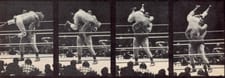
Hulk Hogan and Andre the Giant during the Superdome Showdown, December 1980. The Wrestler Magazine, Wikimedia Commons, Public Domain.
The high-brow world of academia can learn a great deal from professional wrestling. Although the two worlds are rarely equated, the parallels are more substantive than they first appear.
Professional wrestling is one of the great populist art forms: campy, visceral, and yet surprisingly sophisticated in how it navigates tensions between performance and authenticity. But, much like academia, it also is a world where unique individuals build careers through creativity, navigate rigid status hierarchies, and learn early that the performance is the point. Given these similarities, two key concepts from wrestling’s campy lexicon are also worth considering in the world of higher education: kayfabe and the shoot interview.
Understanding both of these concepts will help academics do their work more impactfully and with greater candor. Academics can benefit from acknowledging tensions between performance (which is central to kayfabe) and authenticity (which is the purpose of the shoot interview) in professional settings, as well as having safe outlets to communicate openly and honestly as part of their search for truth.
Carnival Culture
Kayfabe, now enshrined in the Merriam-Webster dictionary, refers to the convention of presenting staged performances as genuine. The term, pronounced kay-fayb, likely originated in carnival culture, where wrestlers and promoters guarded the scripted nature of their craft as a trade secret. For decades, wrestlers maintained kayfabe with near-religious devotion: Heroes and villains stayed in character in public, and exposing the business as something staged could end a career. Eventually, the secret trickled out.
Since 2000, use of the word kayfabe has skyrocketed in print, as wrestling in general, and wrestling vernacular in particular, has seeped into the broader cultural consciousness. Today, kayfabe is routinely invoked to describe the performances of politicians, executives, and other public figures whose public personas may not reflect their private beliefs.
Sociologists will recognize this territory. In his landmark 1959 book, The Presentation of Self in Everyday Life, Erving Goffman argued that social life is fundamentally dramaturgical: We all perform on a “front stage,” carefully managing impressions, while reserving our unvarnished selves for the “backstage.” Goffman could have been describing professional wrestling. The squared circle is the ultimate front stage, a place of exaggerated heroes, dastardly villains, and melodramatic betrayals. The locker room is the backstage, where bitter public rivals share road stories and talk shop.
Professional wrestling is one of the great populist art forms: campy, visceral, and surprisingly sophisticated in how it navigates tensions between performance and authenticity.
But Goffman’s binary of front and back is too clean. Professional wrestling is instructive precisely because it has developed an elaborate vocabulary for the gray areas between performance and reality, areas where the front stage and backstage bleed into each other in ways that Goffman’s framework did not anticipate.
In wrestling parlance, a “work” is anything done in service of kayfabe: scripted, strategic, performed. A “shoot” breaks kayfabe entirely; it is unscripted, candid, real. And then there is the paradoxical “worked shoot,” a performance designed to invoke the feel of authenticity, a controlled breaking of the fourth wall—the barrier separating performer and audience—that serves a greater narrative purpose.
When famed wrestler CM Punk sat cross-legged on the entrance ramp in 2011 and delivered his famous “pipe bomb” promo, airing real grievances about backstage politics while technically following a script, fans could not tell exactly where the performance ended and the truth began. That was the whole point. Modern wrestling lives in these gray areas. Today’s fans know that matches are predetermined and that rivalries are largely fictional, yet they remain captivated precisely because the boundaries between real and performed are perpetually blurred. Even kayfabe can betray glimmers of truth.
Anyone who has spent time in academia will find these dynamics painfully familiar. Consider the academic conference, that great arena of scholarly kayfabe. Attendees deliver polished performances, reenact status hierarchies, and strategically position themselves for advancement. Job candidates feign enthusiasm for positions they would never accept. Senior scholars fake magnanimity toward junior colleagues whose work they privately dismiss. Panel Q&As devolve into thinly disguised self-promotion performed as intellectual curiosity.
At a recent conference, an especially ambitious colleague of mine proudly posted selfies with high-status scholars whom I have repeatedly heard her disparage in private. In academia, the distance between kayfabe and authenticity can be vast.
To be fair, kayfabe is not entirely pernicious. For instance, scientific communication is, and often should be, a carefully constructed performance. We present findings with measured language, we situate our work within existing literature, we perform the rituals of peer review. These conventions exist for good reasons. However, we lose a great deal of understanding when we refuse to acknowledge, let alone interrogate, the unbridled truths lying beneath the performance.
Get Real
The cost of unchecked academic kayfabe can be severe. Consider the case of Zoé Ziani. While completing her Ph.D., Ziani was among the first researchers to detect statistical anomalies in the work of Francesca Gino, a celebrated Harvard Business School professor who was later found to have fabricated data across multiple studies. When Ziani included a detailed critique of Gino’s research in her dissertation, Ziani’s committee members balked. One compared academic discourse to “a conversation at a cocktail party,” advising Ziani to adopt a more deferential tone. Another called her analysis “inflammatory” and accused her of striking a “self-righteous posture.”
Under pressure, Ziani removed the critique. She later collaborated with the investigators at Data Colada, who ultimately exposed Gino’s fabrications, vindicating the very concerns Ziani’s mentors had suppressed. This is academic kayfabe at its worst: a culture where deference to status hierarchies and performative collegiality is enforced even when the data is screaming that something is wrong. Even worse, the privilege to communicate honestly in academia can be constrained for less powerful scholars, often at the behest of the interests of their more powerful counterparts.
This is why I believe academia needs its own version of the shoot interview. In wrestling, the shoot interview is a genre unto itself: a long-form, candid conversation in which a wrestler drops the character and speaks honestly about their career: the politics, the injuries, the grudges, the regrets, the creative battles, the moments of genuine joy. These interviews run the full emotional continuum from bitter to hilarious to deeply reflective. They are compelling precisely because they offer something the performance cannot: the truth, or at least something much closer to it.
Unlike in wrestling, academic shoot interviews need not be dramatic or inflammatory. They could take the form of intellectual biographies that go beyond the sanitized origin stories we tell at job interviews and conferences. Or they could focus on how scholars actually arrived at their ideas, what failures shaped their thinking, which professional norms they find stifling, and what they really believe about the state of their fields.
Imagine a senior scholar candidly discussing a published paper that he no longer believes, a department chair acknowledging the political dynamics that actually drive hiring decisions, or a journal editor admitting which review practices she considers performative theater. These would be extraordinary learning opportunities, both intellectually and professionally.
In academia, we get plenty of performances, whether in print or in person. We need to complement those performances with truths, both the ugly and the beautiful kind. Viewpoint diversity, after all, is only possible when people feel empowered to speak honestly.
Even in a world of predetermined outcomes, professional wrestlers put their bodies and careers on the line every single night. The risks are real, even when the storylines are contrived. Mick Foley, the wrestler, bestselling author, and unlikely philosopher, titled his second memoir Foley Is Good: And the Real World Is Faker Than Wrestling. He was onto something. The paradox of kayfabe is that the performance can be simultaneously fake and profoundly honest.
In academia, we get plenty of performances, whether in print or in person. We need to complement those performances with truths, both the ugly and the beautiful kind.
I am not arguing that scholars should be bashing each other constantly, nor that we must bare our souls at every opportunity. Sometimes there are good reasons to be taciturn, to play along, to maintain a polite fiction. And I will freely acknowledge the worked-shoot quality of this very essay, using the language of entertainment to make serious points about intellectual honesty.
But right now, the continuum in academia is badly skewed. We get far too much kayfabe and far too few shoots. We need more candor, more willingness to break character, and, crucially, the institutional courage to let people do so without reprisal. The squared circle and the ivory tower have more in common than either would care to admit. It is time for more academics to put their public personas aside, step through the ropes, and cut a shoot.

About the author
Kyle Siler, Ph.D., is a Postdoctoral Fellow at the Mike & Sofia Segal Center for Academic Pluralism and a Visiting Scholar at the University of Toronto Data, Equity and Policy Lab.